Review of Material from Music Theory and Composition 2
Introduction
Hello! Welcome to the first class of Music Theory and Composition 3. This course is designed to provide you with experiences and tools that will assist you in your own musical development. Each lesson will offer four main topics along with a repeating fifth topic called "Composers on Composing." The course will start with a review of Level 1 and 2 material, which includes major key, minor key, blues, modal interchange, secondary dominants, approach notes, non-harmonic tones, voice leading, guide tone lines, hybrid chords, bass and drum grooves, and traditional harmony concepts.
From there, Level 3 will take off in new directions, expanding all of these topics. From there the course will move into extended dominants, related II chords, substitute dominant chords, Neapolitan and augmented 6th chords, diminished 7th chords, modal minor, and a thorough look at modulation.
Like Level 1, you will be assigned weekly compositional assignments, which will prepare you for a capstone project by the end of the semester. Included in each lesson are a number of practice exercises designed to help you internalize the topics of the week. You will work with your classmates and teacher to create a positive and supportive learning environment for all and experience music through the eyes and ears of the group. As stated earlier, lesson 1 is a review of Level 1 and 2 material and will give you a strong foundation continuing on with the new materials in Theory and Composition 3.
Make sure you have gone over the Getting Started pages of this course and completed the test on the "Test Your DAW Software" page before looking at Assignment 1 of this lesson.
Objectives
By the end of the lesson, you will be able to:
understand major key harmony applied to triads, 7th chords, and voice leading, as well as major key modes and tensions
understand minor key harmony as applied to triads, 7th chords, and voice leading, as well as natural minor, harmonic minor, and composite scales
identify, construct, and label chords created from figured bass
identify, construct, and label chords borrowed from minor key for major key usage
identify, construct, and label secondary dominant chords
identify, construct, and label hybrid chords
recognize melodic and harmonic 12-bar blues form
construct bass and drum grooves in different styles and meters
identify common, simple musical forms
Why, That’s a . . . !: A Review of Notational and Analytical Nomenclature
Symbols have been used throughout time to represent ideas and sounds. Many cultures around the world have created systems and symbols for writing down their music. Examples 1 and 2 show two non-Western systems that have been used to write down musical thoughts in Indonesia and Tibet. Compare the systems to what you have learned about Western notation. What is similar and what is different?
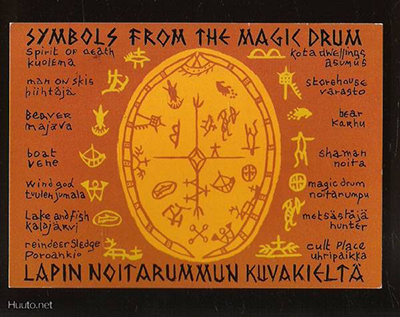
Symbols from the Magic Drum
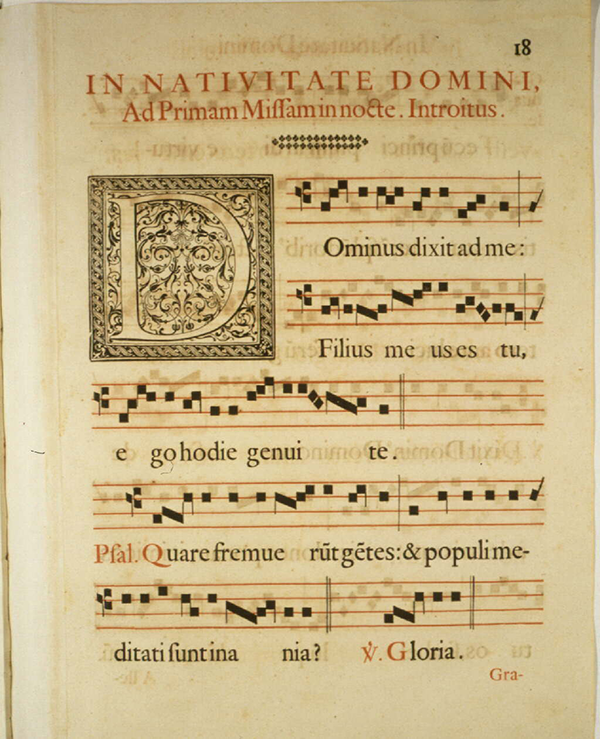
Here are some examples of notation from various cultures and time eras:
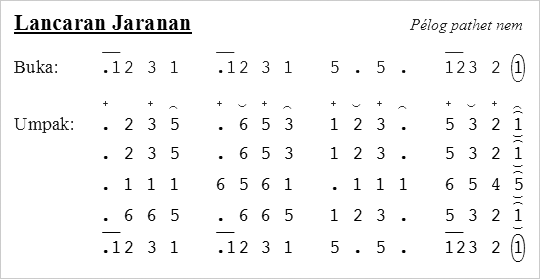
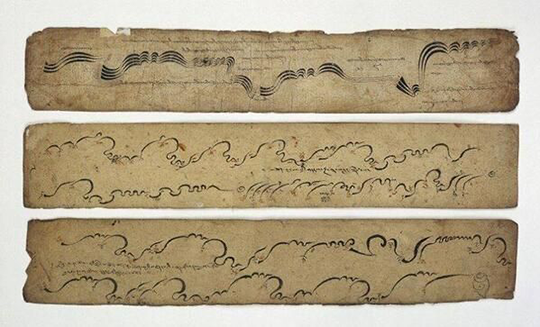
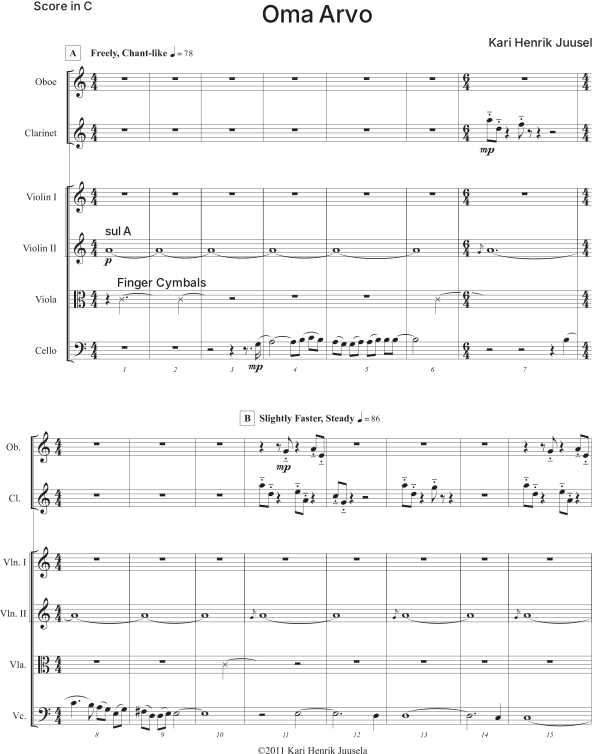
In the Indonesian system, the numbers represent the scale degrees and the lines above the numbers represent two in the space of one beat. In the Tibetan system, the curved lines represent the shape of the melody. Both methods convey a general description of the music, but neither provides enough guidance for the performers to be sure that the intent of the writer is being realized without the performer having a deep knowledge of the music or having the writer present.
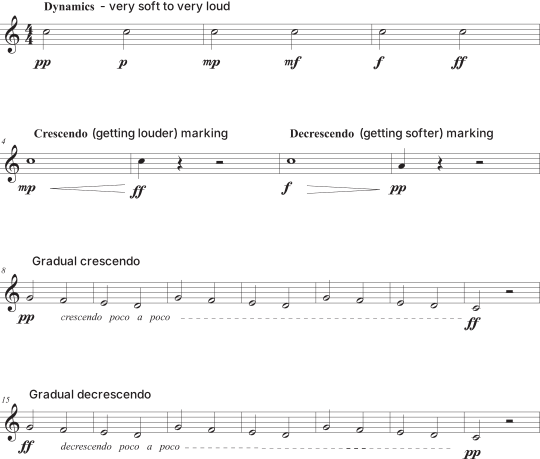
Western music notation attempts to include enough information for performers to realize a piece of music without having an expert present to guide the performance. In Music Theory and Composition 1 we explored the evolution and history of the Western European music notation system. Perhaps, due to its richness, the Western European system has become the most widely used notation system across the globe. In addition to learning notation that represents pitches and rhythms, you learned the most common symbols for dynamics (musical loudness and softness), articulations, and tempo. Over time, in addition to notation, a vocabulary and symbols for use in musical analysis have also developed. In this series of classes you have learned and will continue to expand your knowledge of symbols and vocabulary for analyzing both contemporary and traditional (classical) music.
The Basics: Music Symbols Review
Before we jump into new topics, let's begin by reviewing the terminology, symbols, and concepts that were introduced in Theory and Composition 1 and 2.
Staff
The staff evolved from a single line to five parallel lines with each line and space representing a note.

Clef
A staff by itself doesn't tell us what notes the lines and spaces represent. Clefs were created to indicate which line represents G4 (the G above middle C) or F3 (the F below middle C). In addition to these two clefs that we commonly refer to as the treble clef and bass clef, a family of clefs (C clefs) were created to show where middle C is. Two of the C clefs, alto and tenor, are still commonly used. When only rhythms are notated, a percussion clef is used.

Notes and Rests
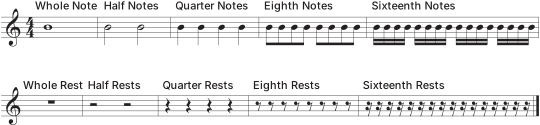
Notes indicate the onset and duration of a sound, and rests indicate the onset and duration of silence. The combined values of the notes and/or rests in each measure must agree mathematically with the time signature. Note and rest values are indicated by open and closed noteheads, stems, flags, and beams.
Tuplets
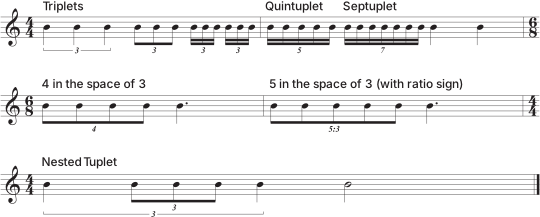
If an odd number of subdivisions are required, tuplets are used to indicate the number of subdivisions. Triplets, three notes in the space of two, are the most common tuplets. However, tuplets may also indicate subdivisions such as five in the space of four, seven in the space of four, or even four in the space of three in a compound meter such as 6/8. Tuplets may be "nested" within tuplets.
The example below shows an eighth-note triplet nested within a quarter-note triplet.
Time Signature
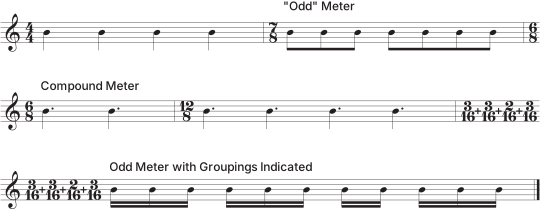
Measures, created by bar lines, show groupings of notes, making it easier for the performers to read music and to show what the prevailing meter is. The bottom number of a time signature indicates the note value getting the beat and the top number indicates the number of beats per measure. Remember to "beam to the beat" and show correct groupings in compound meter and desired groupings in odd meters.
Chord Symbols
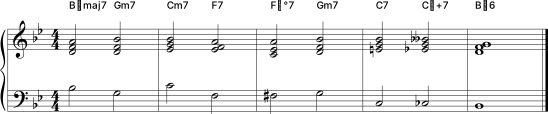
Letter-name chord symbols are a relatively recent addition to music notation. Chord symbols identify the root of the chord and the chord quality. We'll review their construction in an upcoming topic.
Common Articulations and Score and Technique Indications
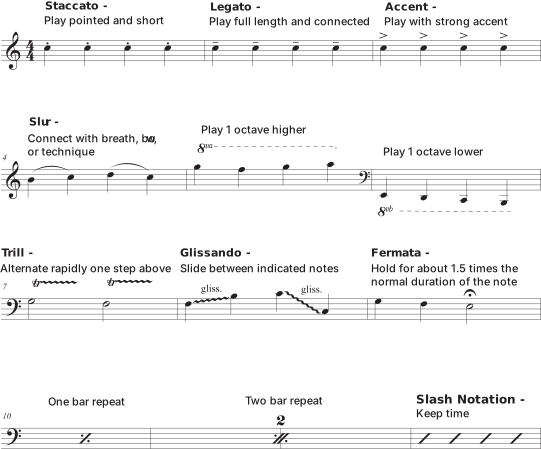
Articulations indicate how the performer is to perform a specific note or group of notes. Here are a few common articulations and score and technique indications that will be useful in creating your scores.
Dynamics (Loudness)
Performance Directions
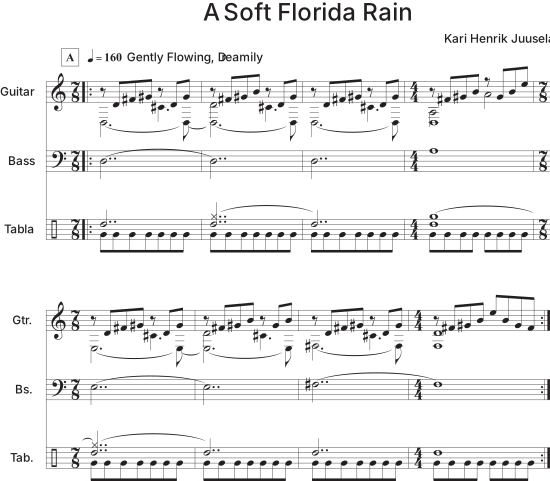
In setting up a score, the composer or arranger should include a marking showing tempo (most often in BPM) and style. Instrumentation should also be clear—as well as any scordatura (atypical instrument tunings).
The Right Stuff: A Review of Basic Diatonic and Diatonically Related Materials
Much in the same way that painters use pigments, notes, scales, and chords can be thought of as the colors with which we write music. A splash of DMa7(♯11) at the right moment may create a bright sparkle and a slowly descending Locrian scale may conjure up a dark subterranean world.

Chromatic Typewriter
Let's continue our review by examining some of the chords, scales, and concepts that were introduced in Music Theory and Composition 1 and 2.
Chord Spelling Review
Triads
Triads—three-note chords—have been the foundation of Western tonal music for about 600 years. The harmony used in this music is often referred to as tertian harmony. In other words, harmonies built in thirds. The two kinds of thirds used as building blocks for the triads are the minor third (3 half steps) and the major third (4 half steps). The four primary triads that are built in thirds are the diminished triad, minor triad, major triad, and the augmented triad.

Two other three-note chords have come into common use in contemporary harmony. They are the sus4 chord and the sus2 chord. In traditional classical music a sus chord was thought of as a suspension and needed resolution. In contemporary usage, the sus chords can stand on their own and do not require resolution. The sus4 chord replaces the 3rd of a triad with a 4th and the sus2 chord replaces the 3rd with a 2nd.

Test your knowledge of triads, sus4, and sus2 chords with this practice workshop:
Adding Thirds
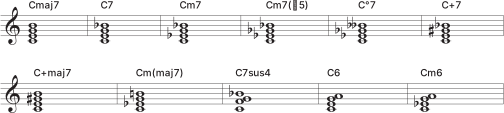
Composers as early as in the 1500s began to enrich the basic triads by adding more thirds resulting in 7th, 9th, 11th, and 13th chords. Added 7ths became so common that by the mid-20th century the basic chord was thought to consist of a root, 3rd, 5th, and 7th.
Below is the family of typically-used 7th chords that were covered in Music Theory and Composition 1 and 2.
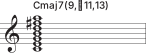
Stacking more thirds above a seventh chord creates 9, 11, and 13 chords.
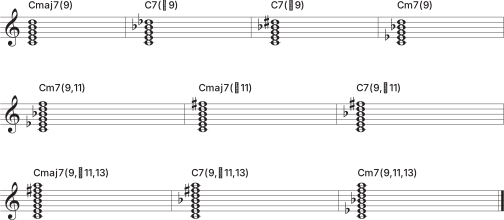
The choice of which tensions to use depends on the quality of the 7th chord and the available tensions (more tension review below). The most consonant tensions are those that are a major 9th above the notes of the primary triad of the chord. 


Some often-used 9,11,13 chords:
Test your knowledge of chords with added thirds with this practice workshop:
Inversions
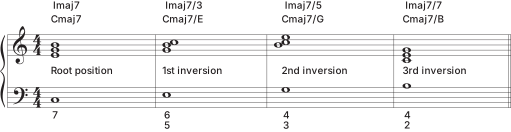
When chords do not have their root in the bass (lowest voice) they are considered to be an inversion. Below is a review of 7th chord inversions. Root position has the root in the bass. First inversion has the 3rd in the bass. Second inversion has the 5th in the bass. Third inversion has the 7th in the bass. The chord symbols for the inversions are shown above the staff along with the Roman numeral designation. The figured bass symbol for the inversions are shown below the staff.
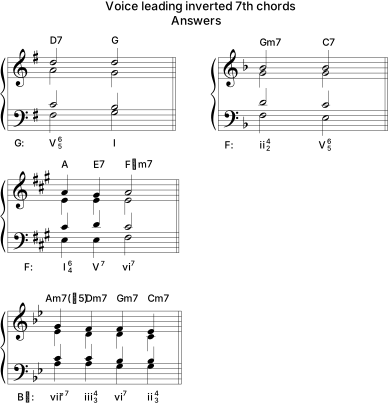
In order to get comfortable with voice leading inverted 7th chords, analyse the following practice examples and add the chord names above the staff and the Roman numerals below. Complete the missing alto and tenor parts and voice lead according to the common practice procedures. Remember that if there are no numbers (figures) under a chord it means it is a root position triad.
Download Inverted 7th & Secondary Dom. Chords Worksheet (PDF)

Scale Review
The major scale has most likely become the most used scale in the world today. Its bright sound and rich interval and chord possibilities have seduced listeners and composers. The 12-tone tempered chromatic scale makes it possible to have 12 transpositions of the major scale making up 12 different key centers.

The natural minor scale is also called the relative minor scale since it is constructed from the same notes as a major scale only starting on the 6th scale degree.

Now, see if you can identify all of the major scales, their relative minor scales, and the number and kind of accidentals in the key for each. Fill out the chart, and then check your work below.
Use a lowercase "b" for flat, "#" for sharp, and "-" for minor. Example:
Major Key |
Number/Kind of Accidentals |
Relative Minor Key |
C |
0 |
A- |
F |
1b |
D- |
The harmonic minor scale has a raised 7th scale degree giving it a leading tone and therefore a V chord to act as a dominant.

1. To practice this concept, construct the E, G, F, and B harmonic minor scales.
Download Blank Manuscript Paper (PDF)
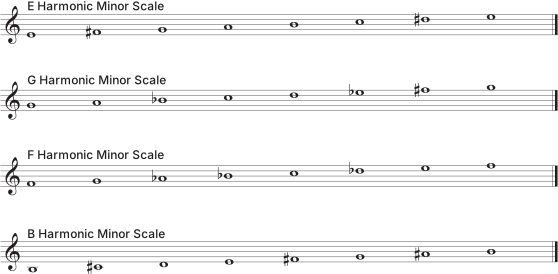
2. Play the E, G, F, and B as minor scales and then as harmonic minor scales on your keyboard or the  virtual keyboard (bottom, right-hand corner of the page) to listen to the difference the raised 7th makes.
The melodic minor scale has an ascending and a descending version. The upper tetrachord (four-note set of notes) of the ascending version is similar to major and the descending has the same upper tetrachord as the natural minor scale.

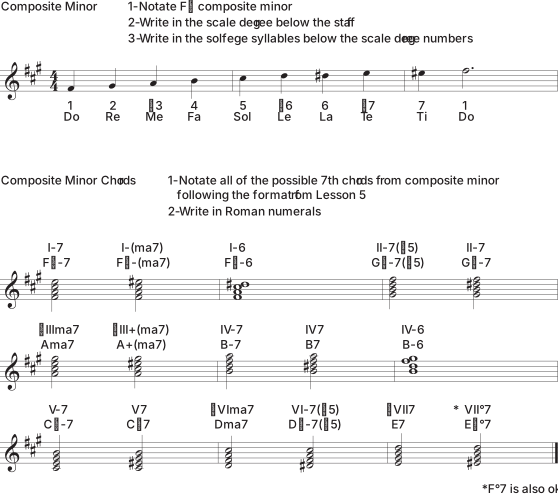
The composite minor scale combines the natural, harmonic, and melodic minor scales giving it a rich array of melodic and harmonic possibilities.

In order to experiment with your understanding of composite minor, complete the following practice sheets and then check your answers.
-
Composite Minor
Download Composite Minor Worksheet (PDF)
RevealContent -
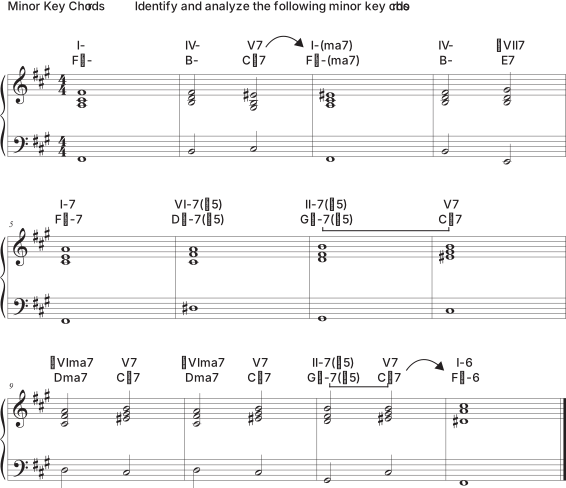
Minor Key Chords
Download Minor Key Chords Worksheet (PDF)
RevealContent
Modes
Modes, or Church Modes as they are sometimes referred to, are seven-note scales that were the foundation of early Western music. Boethius, a sixth-century scholar, translated Greek musical treatises into Latin and the Greek mode names were brought into early Roman Catholic church music. The makeup of the Greek modes differed from the Roman Catholic Gregorian scales, but the names stuck. Similar to Indian ragas, each of the modes was thought to have a unique sonic character and mood. Initially, only four modes and a hypo (plagal) version of each were used. The four original modes were Dorian, Phrygian, Lydian, and Mixolydian. Later, the set of modes expanded to six by adding the Ionian and Aeolian modes. The modern modal system was completed by theorists in the twentieth century with the addition of the Locrian mode.
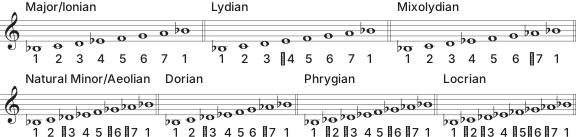
Modern modes are displacements of the major scale (Ionian mode). Although they are related, modern modes are used as descriptions for chord scales and modal tonic systems (explored in Music Theory and Composition 4) and are treated differently than the church modes of the Medieval and Renaissance periods.
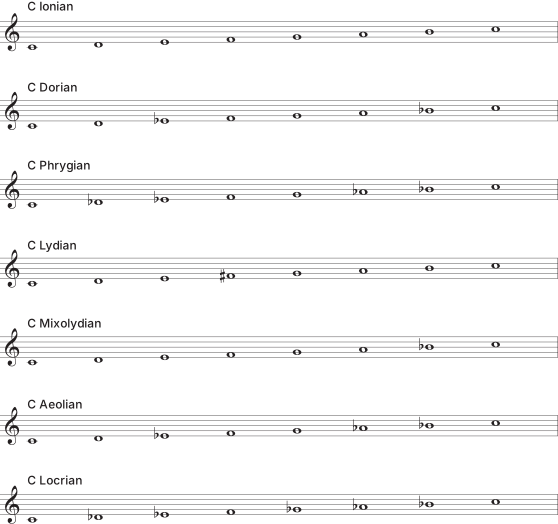
Write out and label the seven parallel modes starting on the notes G, F, D, and B
Download Blank Manuscript Paper (PDF)



Chord Scales, Harmonic Avoid Notes, and Tensions
A chord scale is a linear representation of a complex chord that includes tensions and non-chord tones arrayed within an octave. Chord scales can be a useful tool for composition, arranging, improvisation, and analysis (see the Major Key Modes Relative to G Major graphic below).
Harmonic Avoid Notes
A harmonic avoid note (HAN) is a note that is a member of the prevailing chord scale and is diatonic to the key, but creates a harsh dissonance and/or is stylistically unacceptable when sustained against the basic chord. When writing a chord scale, HANs are labeled "S" (for scale degree) since they are part of the chord scale but are not acceptable extensions of the basic chord (see the Major Key Modes Relative to G Major graphic below).
Tensions
Tensions are extended tertian chord tones (notes) that are not members of the primary triad or 7th chord. In a chord symbol, they are labeled as 9, 11, or 13. In a chord scale they are labeled T9, T11, and T13 (see chord scale example below). When adding tensions to a chord symbol, write the tensions in ascending order in parentheses after the chord symbol. The 7th is considered a member of the chord, not a tension, and should not be in parentheses.
Below is a review of the chord scales that match the major key chords with each note labeled against the chord.
Each of these modes can be labeled in relation to the chord, hence the name chord scale. These labels show the hierarchy of pitch inherent in scales, a musical element that in general helps to create tonality. The chord tones in the chord scale are stable notes of the chord, while the tensions, represented by T, are pitches that support the basic chord sound and key, and help to create a thicker chord sound. Harmonic avoid notes, also referred to as avoid notes, are unstable notes within a chord scale. Often, these notes are the characteristic pitch of the mode. When used melodically, they help support the key, but if used harmonically, they create disharmonious intervals within the chord structure that do not support the chord quality or its harmonic function.
Major Key Modes Relative to G Major:
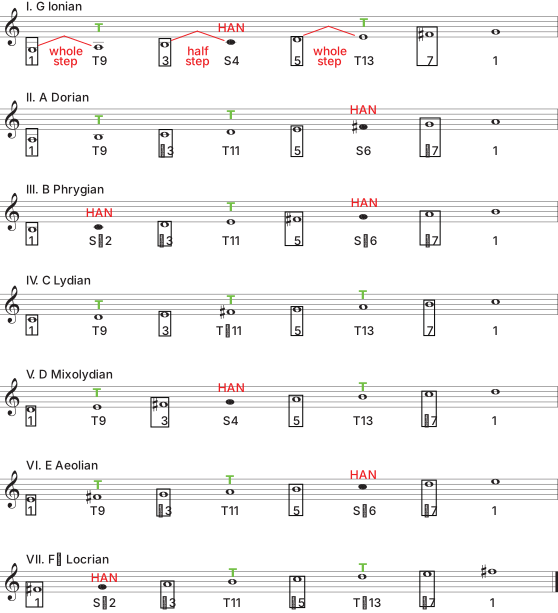
Chord scales, tensions, and harmonic avoid notes will be addressed in more detail throughout this course.
Let's review harmonic avoid notes (HAN) and tensions in the major key modes relative to A Major.
Roman Numerals
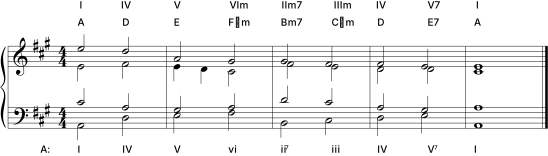
Roman numerals are used to identify a chord's relationship to the tonic of a key and the chord's quality. Contemporary analysis uses all upper case Roman numerals placed above the staff and traditional (classical) analysis employs a mixture of upper and lower case Roman numerals placed below the staff. In traditional analysis upper case Roman numerals are used for major and augmented chords and lower case are used for minor and diminished chords.
Major Key Roman Numeral |
Major Key Chord Scale |
Ima7 |
Ionian |
II-7 |
Dorian |
III-7 |
Phrygian |
IVma7 |
Lydian |
V7 |
Mixolydian |
VI-7 |
Aeolian |
VII-7( |
Locrian |
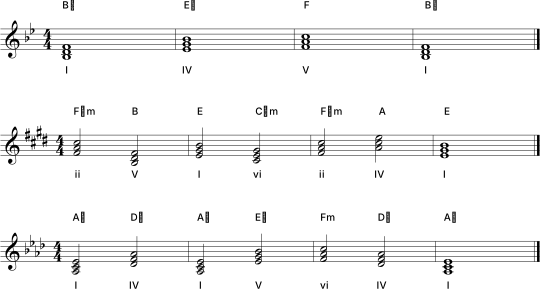
1. Analyze the three examples below using Roman numerals.
Download Roman Numeral Harmonic Analysis Worksheet (PDF)






2. Review the three examples you analyzed above and add a traditional Roman numeral analysis below the staff.
Function
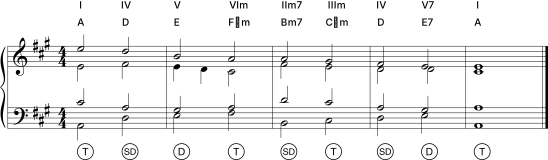
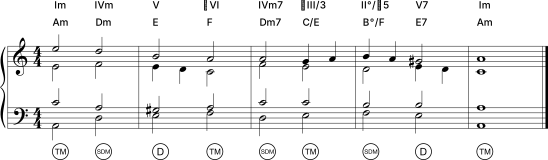
In tonal harmony, each chord has a harmonic function. Harmonic function describes a chord's relationship to the tonal center. The chords function by creating and resolving motion around the tonic pitch. The primary three functions in diatonic harmony are tonic (T), subdominant (SD), and dominant (D). In major key, the I, III-, and VI- chords have a tonic function. The II- and IV have a subdominant function. In contemporary music, the V chord serves as the main dominant chord. In traditional (classical) music the VII° chord functions as a slightly weaker dominant. In contemporary harmony, the VII° is not often used as a dominant chord.
In harmonic minor the I-,
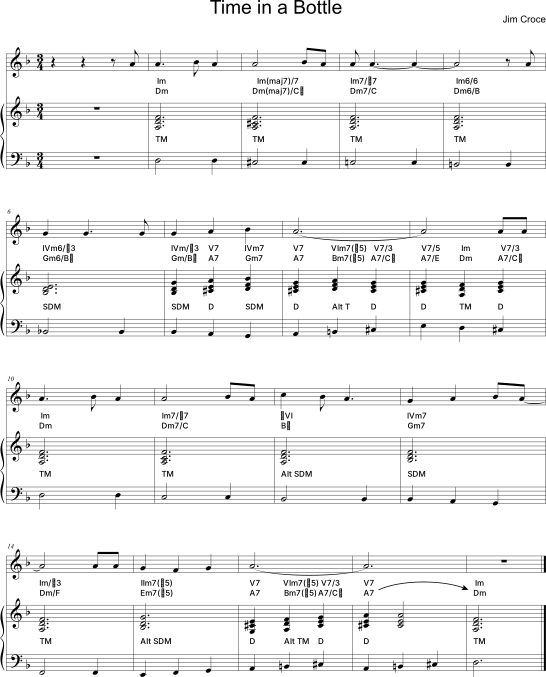
For practice, listen to and then write a chord analysis to Jim Croce's "Time in a Bottle." When you complete that, go back and write in the harmonic function below the chord names. Take some time to consider the harmonic phrasing that is presented in this song.
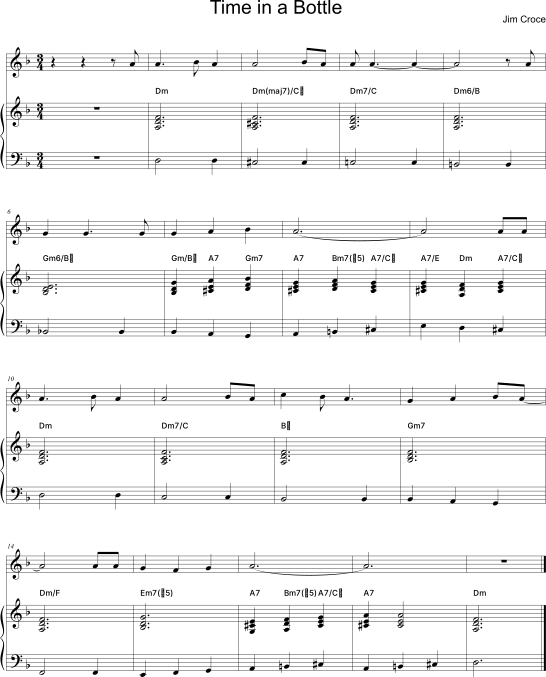
Jim Croce. "Time in a Bottle," from Songs about Heartbreak. (Goldenlane Records/2014).
Download "Time in a Bottle" Chord Sheet (PDF)
Secondary Dominant Function
Secondary dominant chords are dominant 7th chords that are not diatonic to the key. They act as a dominant to tonicizable diatonic chords (in major key: II-, III-, IV, V, VI-) whose root is a perfect 5th below. The dominant resolution is shown by the arrow going from the dominant chord to the target chord that is a perfect 5th below.
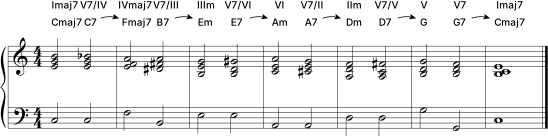
In order to become more familiar with secondary dominants, take some time to figure out a few other sets of secondary dominants in other keys. You can identify the key by looking at the target chords. You can also hover the cursor over the space to see the answers.
Secondary Dominant |
Diatonic Chord of Resolution |
F#7F#-7? |
B-7 |
G#7? |
C |
A7? |
Dma7 |
B7? |
E7 |
C#7? |
F |
Secondary Dominant |
Diatonic Chord of Resolution |
Bb7? |
E |
C7? |
F-7 |
Db7? |
G |
Eb7? |
A |
F7? |
B |
Secondary Dominant |
Diatonic Chord of Resolution |
E7? |
A-7 |
F#7? |
B-7 |
G7? |
Cma7 |
A7? |
D7 |
B7? |
E-7 |
Modal Interchange
Modal interchange occurs when chords are "borrowed" from a parallel major or minor mode. In major keys, the most typical borrowed chords are IV- and
Modulation
Modulation occurs when the tonal center changes within a song or piece of music. It is considered a close modulation when the key changes by one sharp or flat. Distant modulations occur when the key changes by more than one sharp or flat. Remember that change of mode from major to minor is not considered a modulation. Modulations are marked with an arrow accompanied by a number to show the interval of modulation. The modulation shown in the example below moves from the major to relative minor.
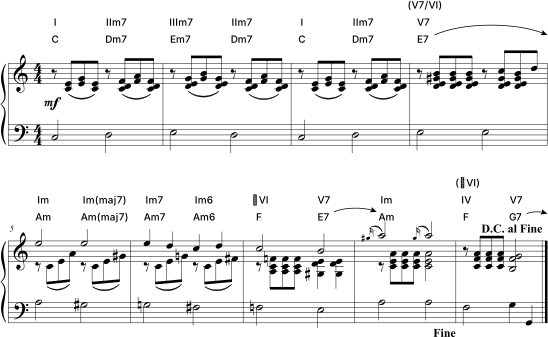
For this workshop:
-
Write up chord comparison charts similar to the example below for the following paired major keys: E
Shared Chord Example:G Major
G I
A- II-
B- III-
C IV
D V
E- VI-
F
D Major
G IV
A V
B- VI-
C
D I
E- II-
F

Identify the modulating note and chord/measure in the following examples.
Song A.
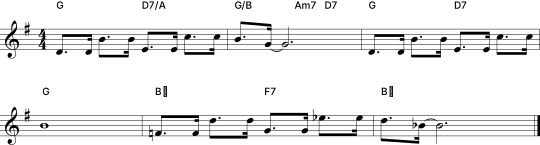
Song B.
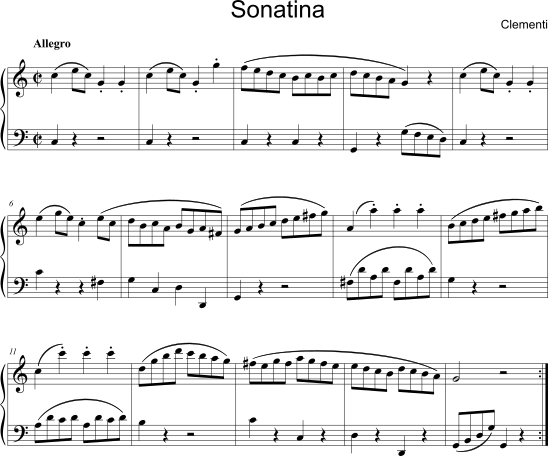
Figured Bass
Figured bass, once used by musicians the way chord symbols are today, is a very useful tool for analyzing and realizing traditional music. We will continue to use figured bass in our explorations of traditional/classical music. Below is a summary of figured bass symbols and their meaning:
Chord tone |
Triad |
Triad |
Triad |
7th Chord |
7th Chord |
7th Chord |
7th Chord |
|
Complete Symbol |
5 |
6 |
6 |
7 |
6 |
6 |
6 |
|
Abbreviated Symbol |
Nothing |
6 |
6 |
7 |
6 |
4 |
4 |
|
How to find the root |
Bass note |
6th above the bass |
4th above the bass |
Bass note |
6th above the bass |
4th above the bass |
2nd above the bass |
Figured bass also can indicate chromatic alterations such as secondary dominants and borrowed chords.
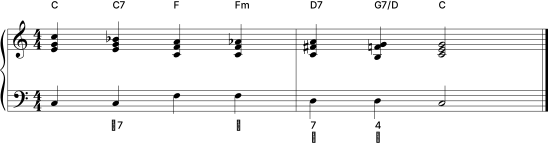
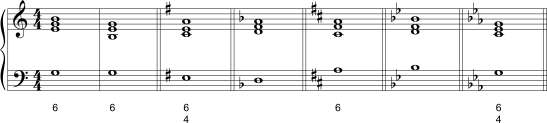
Using the information you've learned about figured bass, complete the chords in the examples below by putting close position triads (all notes within one octave) in the treble clef. There is only one possible triad for each example, but the notes may be in more than one order.
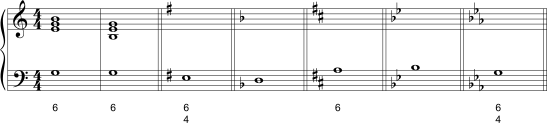
Download Figured Bass Workshop (PDF)
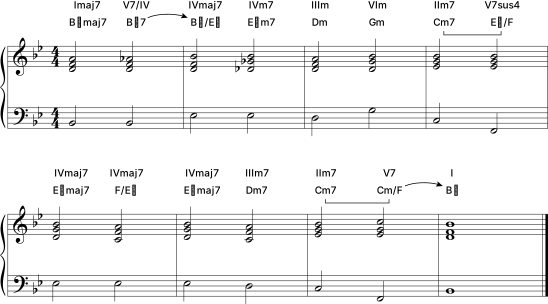
Hybrid Chords
Hybrid chords are constructed from upper-structures and do not include the 3rd of the chord. All chord names for hybrid chords use the slash symbol format. The upper structure chord is written to the left of the slash while the chord root is written to the right of the slash. When analyzed, the chord is analyzed the same way as its counterpart that contains a 3rd. Hybrid chords are also a combination of two things: a root note with a chord whose other notes are made up of upper chord tones and tensions. Although less "hearty" than their counterparts containing a 3rd, they have their own beauty and add a subtle, ambiguous "fragrance" to a chord progression.
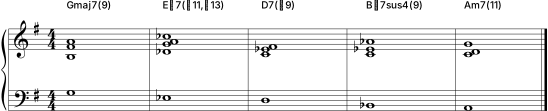
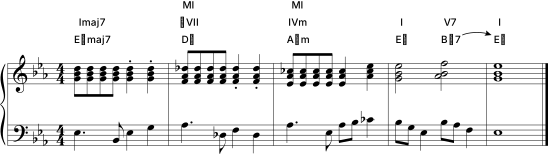
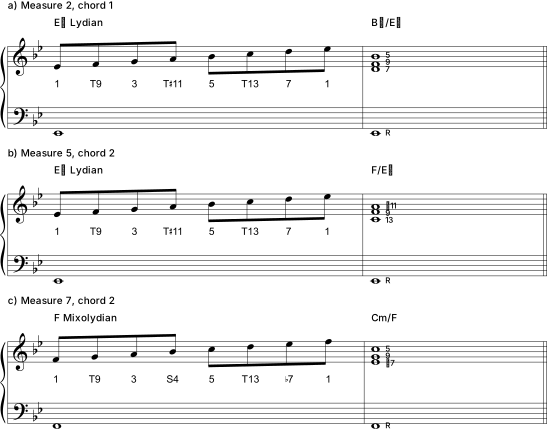
In major key harmony, there are five hybrid chords for the V7 chord. Here are these hybrids in the key of E
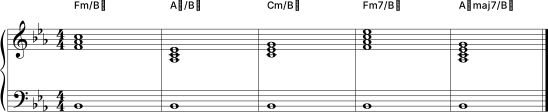
Notice that all of the treble clef chords are built from the 5th, 7th, or 9th of the root. The treble clef chord is commonly referred to as the upper structure chord because it looks like a chord separate from the root, which is reflected in the chord name.
All chord names for hybrid chords use the slash symbol format. The upper structure chord is written to the left of the slash while the chord root is written to the right of the slash. When analyzed, the chord is analyzed the same way as its counterpart that contains a 3rd.
In order for you to hear these chords more clearly, it would help for you to play these chords on a keyboard so you can clearly hear the upper structure triad against the root. Also play these chords in the lower structure voicing with the 3rd present so you can hear the difference between the "regular" version with a 3rd and the hybrid version of the same chord. The following practice exercise will also give you more time with these chords so you can start to incorporate them into your own music.
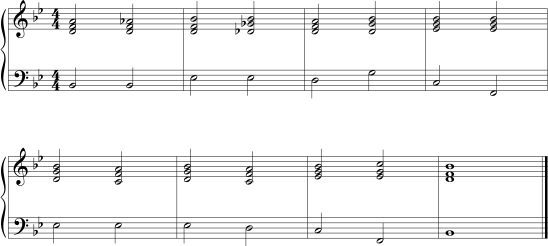
Download Hybrid Practice (PDF)
Harmonic Voice Leading
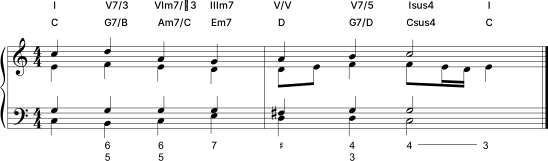
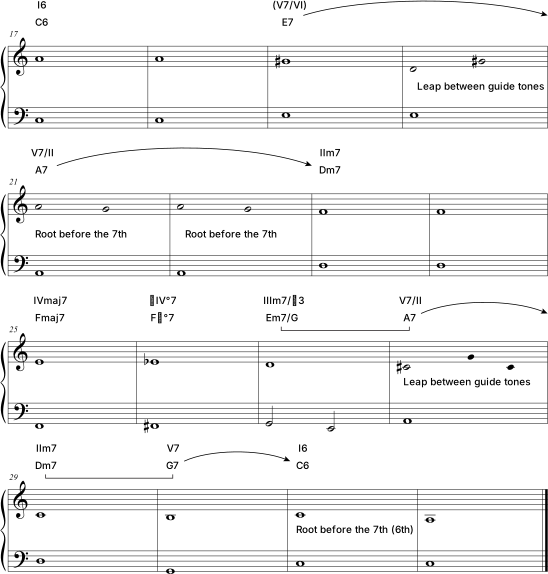
Voice leading creates a smooth flow between chords. The main voice leading principles are to move stepwise between chord tones as much as possible and to keep each voice (line) as independent as possible. When voice leading in a traditional style, it is common practice to avoid parallel 5ths, octaves, and unisons. In traditional style, 7ths of chords are considered dissonances and should be resolved downward to become a chord tone of the following chord. The leading tone (scale degree 7) should be resolved upward if "exposed" (in the top voice or bottom voice). Below is an example of four-part voice leading in traditional style. Note the smooth linear movement of the inner voices.
Guide Tones
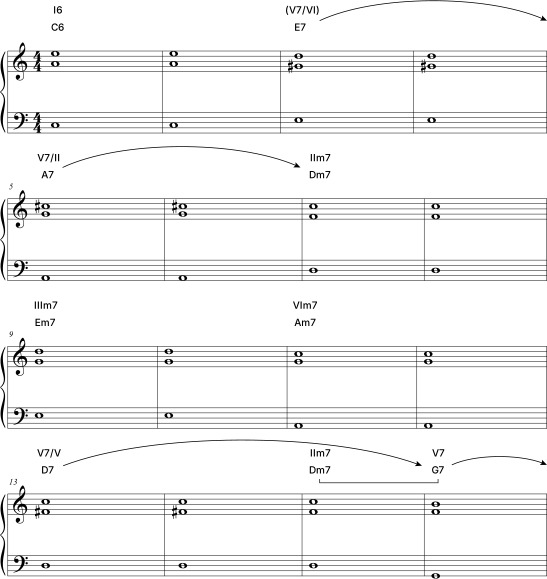
The 3rd and 7th of a 7th chord are called guide tones, because in essence, their sound "guides" you through the sound of the chord quality, meaning, those two chord tones, along with the root, give the most complete sound of the chord. Based on its placement in the overtone series and its relationship to the root of the chord, the P5 of a chord is not significant to the chord sound; when the 5th is altered, as in a -7(
Guide tones are often used in contemporary music as background parts such as string pads and other accompanying figures.
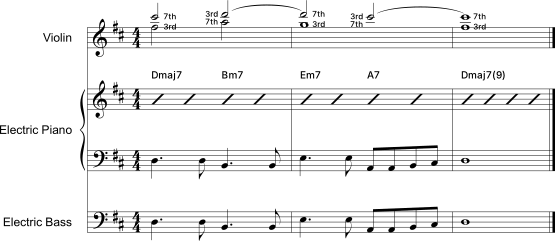
Guide tone lines can also be used to create melodies and they are also a common way to learn improvisation. The following practice will help you to better negotiate guide tone lines so you can apply them to your own musical experiences.
Download Guide Tone Practice (PDF)
Back in the Groove: A Review of Drum Notation, Grooves, and Asymmetrical Meters
Antonio Sanchez
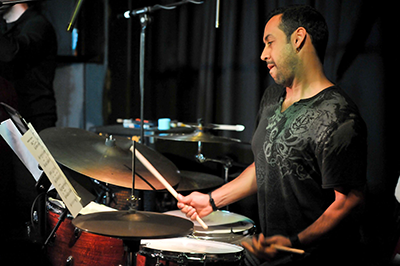
In Music Theory and Composition 1 and 2 you learned the role of the drum set in contemporary music. The drum set not only provides the groove in much of contemporary music but can even become the entire source of a music score, such as in the movie Birdman or (The Unexpected Virtue of Ignorance) in which all of the film's original music is composed and performed by jazz drummer Antonio Sanchez.
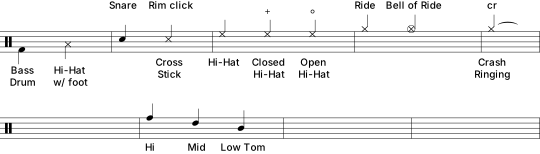
Let's review the components of a standard drum set. Mouse over the text of each drum set component to view.
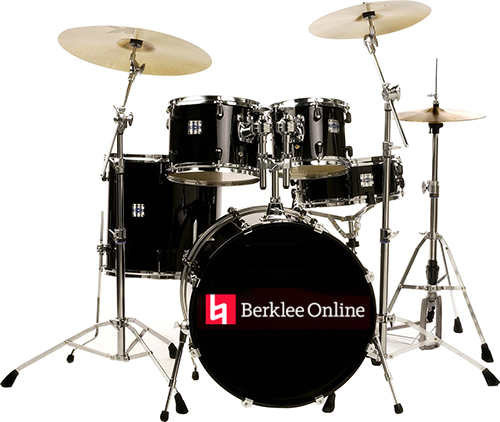
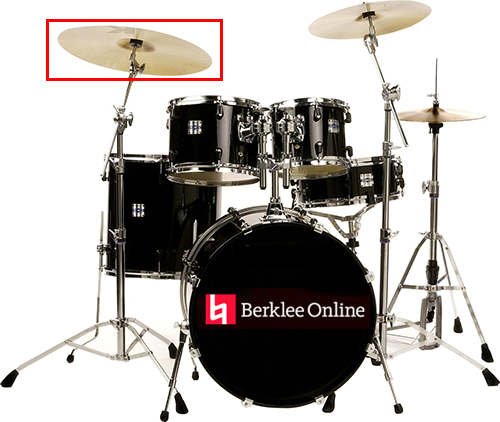
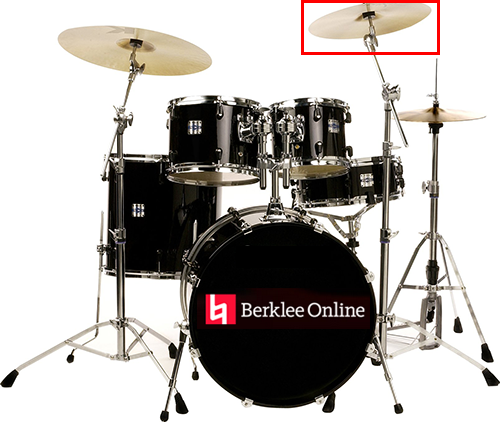
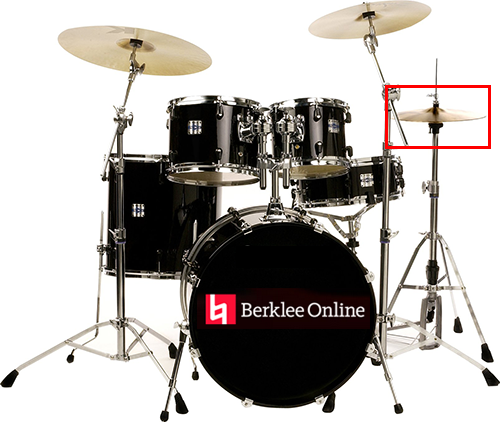
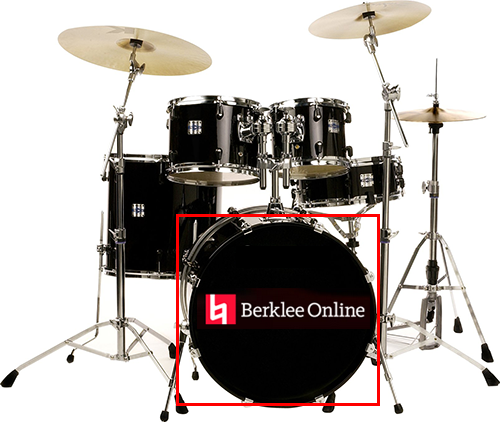
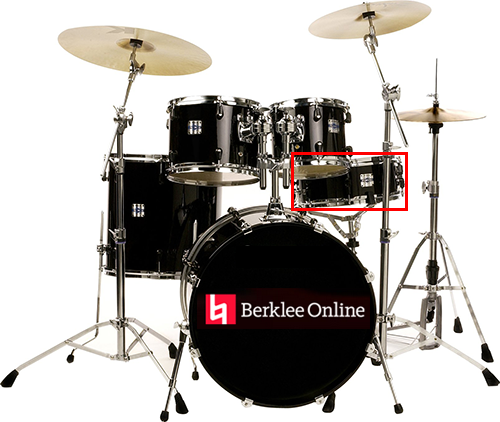
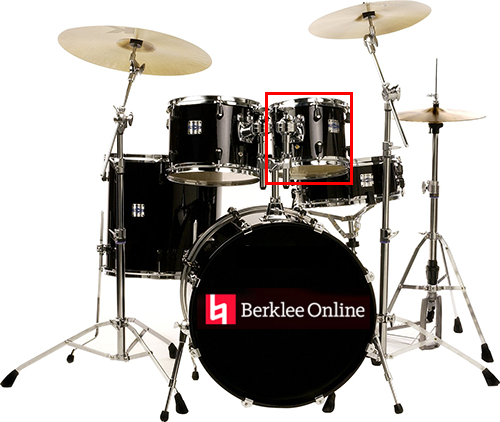
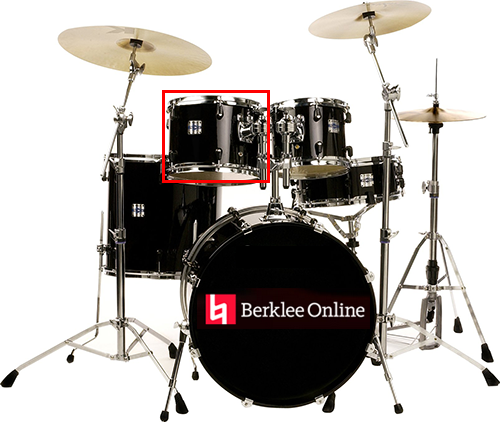
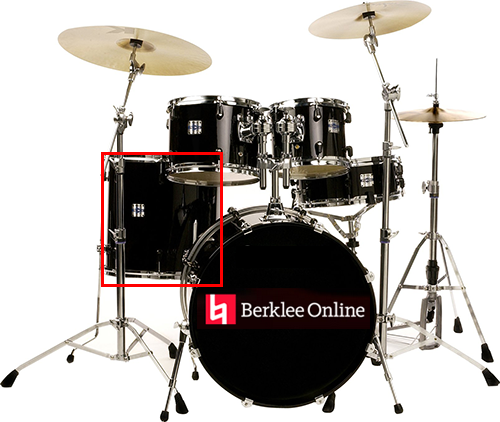
In your composition life, and in this class, you will be called upon to write some basic grooves for drum set. Sometimes you will write the entire groove (especially if you are creating a digital demo or recording) and sometimes, if you have a real drummer, you will probably just supply a basic groove for one or two bars and then ask the drummer to embellish and fill out the groove. Good drummers will vary the groove and add small touches that will make the groove come alive.
Berklee Drum Legend
Although you will see a number of ways to notate for drum set, the Berklee drum legend has become one of the most used drum notation systems. We will use it for this class. It is important that you include a legend that shows which lines and spaces you are using for each drum or cymbal when you notate drum set in a composition or arrangement.
Drums and Bass Groove Styles: Pop/Rock
Here are some basic groove styles you learned in Music Theory and Composition 1 which you can build upon.
The first drums and bass groove we will look at is in the pop/rock style.
Drums:
Hi-hat or Ride: even eighth notes
Snare: 2 and 4
Bass drum: 1 and 3
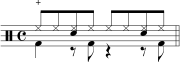
A basic rock drum groove is derived from an even eighth note pattern spread throughout the different parts of a drum set. The eighth notes are commonly played on the hi-hat or ride cymbal with the snare playing a very strong backbeat on 2 and 4. The bass drum can play a simple pattern on 1 and 3 or anticipations and pick-ups can be added, which add to the wide variety of rock derivatives.
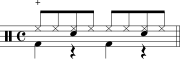
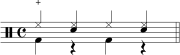
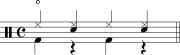
Here are two variations to the previous pattern, also heard in metal. In the first example, the hi-hat is closed and in the second example, it is open.
Hi-hat is closed:
Hi-hat is open:
Here is an example of anticipation and pick-up in the bass drum:
Bass:
Even eighth note patterns
Mix of quarters and eighths
Use of half notes and quarters
A basic rock bass line is derived from an even eighth-note pattern consisting mainly of roots. Anticipating the steady pulse and/or leaving notes out can create alterations to the basic rhythmic pattern. Some lines incorporate use of 5ths,
Basic Pattern:

This variation to the basic pattern uses anticipation and it leaves out some notes in the original pattern. The use of space helps to create rhythmic shape and phrasing.
Rhythmic Variation:

This bass line incorporates octaves,
Added Chord Tones:

Drums and Bass Groove Styles: Funk-Based Pop/Rock Sixteenth Rhythms
Here are the funk-based, pop/rock sixteenth rhythms.
Drums:
Pattern 1.
Hi-hat or Ride: even eighth notes
Snare: 2 and 4
Bass drum: syncopated sixteenth patterns
Pattern 2.
Hi-hat or Ride: even eighth notes
Snare: syncopated sixteenth patterns
Bass drum: syncopated sixteenth patterns
Pattern 3.
Hi-hat or Ride: sixteenth pattern
Snare: syncopated sixteenth patterns
Bass drum: eighth note patterns
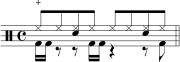
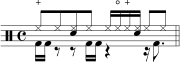
Funk-based drumbeats can sound very different depending upon which drum part is outlining the sixteenth rhythms. When the snare and/or the bass drum is involved, there is a strong emphasis on sixteenth syncopations, meaning, the upbeats are emphasized. These are the sixteenth notes that correspond to the syllable "E" and "A" in the subdivision, "1E+A." Oftentimes, space (silence) is also utilized so the syncopations will stand out. You'll find a mix of eighths and sixteenths among the three main parts of the drums, which creates a lot of possibilities for variations in this style.
In the following funk example, the hi-hat and snare keep a steady eighth pulse, just as they would in a rock style. The sixteenth syncopations are in the bass drum. The second groove shows a variation to the first groove where the snare on beat 4 and the bass drum on the + of 4 are both anticipated into a sixteenth rhythm. Also, the hi-hat provides a sixteenth rhythm with an open hi-hat on the syncopated beat.
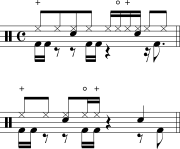
The following drumbeat uses the last drumbeat in the first measure, while measure 2 gives a contrasting sense of space on beat 3 with pick-ups in the snare and bass drum on beat 4 and the + of 4. Notice that when a rest occurs in both the hands and feet at the same time, it is written on the staff where it is written for a single piece of music.
Bass:
In eighth and/or sixteenth patterns that incorporate syncopation and space, the bass most often outlines the roots, 5ths, and
The following bass line employs only one note. As in rock grooves, repetition of pitch is common.

The next bass line shows a variation of the previous line. Like the drum variation, the bass anticipates beats 4 and the + of 4, creating a syncopated rhythm. Also, the bass line incorporates the higher pitched

Drums and Bass Groove Styles: Bossa Nova
Here are the bossa nova drums and bass grooves.
Drums:
Hi-hat or Ride: even eighth notes
Snare: "clave rhythm"
Bass drum: 1, + of 2, 3, + of 4
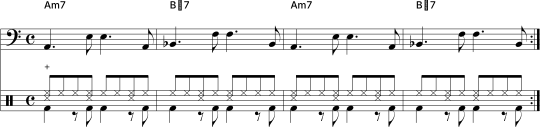
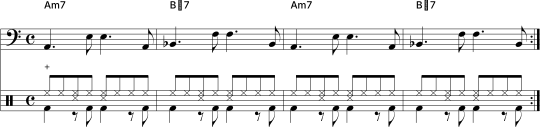
A standard bossa nova pattern incorporates what is known as a "clave rhythm" on the snare. This is played with a rim click, which is notated with an "x" on the snare space. The rim click is played by having the end of one stick resting on the snare head, while the other end is lifted and tapped against the metal rim of the snare drum. The cymbal keeps the time and the bass drum follows a repeated pattern that is also played in the bass.


Bass:
1, + of 2, 3, + of 4
Like the drums, the bass pattern is very consistent. It is most common to use roots and 5ths for this particular pattern.

Although there are variations to a bossa, the pattern does not usually stray too far from the basic groove. Sometimes the clave rhythm is reversed, which can be seen and heard below.
Drums and Bass Together:
Listen to the audio of the previous drum and bass grooves played together:
Drums and Bass Groove Styles: Jazz Swing
Finally, let's look at the drums and bass groove styles for jazz swing.
Drums:
Hi-hat or Ride: quarter and two eighths pattern
Snare: improvised hi-hat with foot: 2 and 4
Bass drum: improvised
Jazz swing drumming is very different from the previous styles. It is meant to keep time, but not to add volume and power; instead, a jazz drummer tries to play more melodically and respond directly to what the other instruments are playing. It is mostly an improvised art form, and although composers may write an outline to a drum part, they usually expect that the drummer will be experienced enough to know what to play. Sometimes parts will not have specifics written out, and often a drummer is just given a copy of the lead sheet of the song so that they can follow the form. Big band charts may be more specific, but often the drum part will only provide the desired accents throughout the piece. This type of writing will be examined in and upcoming topic. Here are a few examples of what a jazz drummer might play:


Notice that in both drumbeats, the steady components are the ride cymbal and the hi-hat with the foot.
Bass:
Relies on root, 3rd, and 5th as well as passing tones and stepwise resolution of non-chord tones
Generally, all quarter notes, with some pick-ups depending upon tempo
The function of a walking line is to provide smooth movement during and between chord changes, while outlining the harmonic structure and creating a steady feel. Based on the overtone series, the root is the fundamental of the chord; without it placed in a low register beneath the chord instrument, the chord will sound like a different chord. Both the 3rd and the 5th occur at the start of the overtone series, giving them the stable sounds of the chord. A basic walking line can be derived from these three chord tones.
Example of a basic walking line:

Variations of a basic walking line:

In the previous lines, the root occurs on the downbeat of each chord change. Playing any other note will change the sound of the chord. There are situations where a bass part might alter the bass motion, but roots should be used to outline the chord changes. Also note that the movement between the chords is smooth because the last note of a chord is voice led into the root of the new chord.
The following line still uses the root on the downbeat of a chord change, but it also uses incorporates linear movement. Measures 1, 2, and 3 employ passing tones from the chord scale, while measure 4 also employs a chromatic passing tone that is not from the chord scale.
Example of a basic walking line with passing tones:

Compound Drum Grooves
The preceding grooves were all in simple meter—meaning time signatures like 4/4 and 2/4 where the normal subdivision of the beat is in 2 or 4. In compound meters, the subdivision of the beat is in 3. 6/8, 9/8, and 12/8 are the most usual compound meters. The drum grooves emphasize the triple subdivision.
As level 1 pointed out, the hi-hat and ride are commonly the timekeepers that outline the eighth-note count. The snare plays the backbeat, which is beat two and four in 4/4 meter. Since 12/8 can be broken into four pulses, this backbeat will be easy to replicate in 12/8. The bass drum provides the rhythm that helps to define the groove. It is also the rhythm that is duplicated in the bass, hence the name "bass drum." Often, the bass drum and snare create rhythmic layering, or a counter-balance, so the combined rhythm defines the groove.
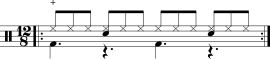
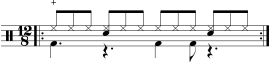
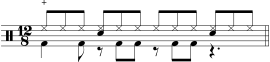
As you can see in the following grooves, the closed hi-hat keeps the steady beat. The snare is played on beats four and ten, which is the second and fourth pulse, like a backbeat. The bass drum works opposite the snare and plays on the strong beats, beats one and three, and gradually changes its rhythm by adding in pick-ups and using anticipation.
Drum Groove 1.
Drum Groove 2.
Drum Groove 3.
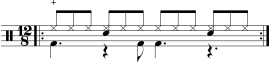
Drum Groove 4.
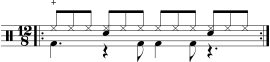
The following two-measure groove is a slightly faster tempo and uses the same pattern in the hi-hat and snare. Notice that the bass drum anticipates pulse three and in the second measure, adds a pick-up to the snare. This drumbeat utilizes space differently because of the anticipations, which significantly changes the groove.

As you can see in the following groove, the closed hi-hat keeps the steady beat. The snare continues the backbeat. The bass drum adds more variety with syncopation.
Drum Grooves in 6/8
Now, we'll look at some drum and bass grooves in 6/8. Keep in mind that it is possible for 12/8 grooves to work in 6/8 and for 6/8 grooves to work in 12/8, however, it depends upon the tempo as well as the melodic, harmonic, and rhythmic phrasing.
As you can see and hear, each of the following drum grooves utilizes pick-ups and anticipations, as you heard in the 12/8 beats. You will hear some changes to the snare and a busier bass drum throughout these grooves.
Drum Groove 1.
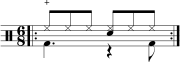
Drum Groove 2.
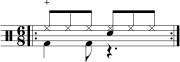
Drum Groove 3.
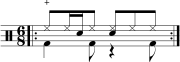
Drum Groove 4.
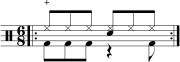
Drum Groove 5.
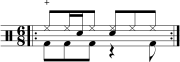
Drum Groove 6.
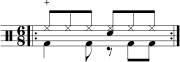
Real World Examples
Here are some real world songs that use some of these grooves:
12/8 Grooves
6/8 Grooves
Listen to the following 6/8 grooves for comparison to the 12/8 grooves:
And for further comparison, here are some songs in 3/4.
Bass and Drums Grooves in 5/4 Meter
Odd meters are a mix of compound and simple. 5/4, for example, can be subdivided 2+3 or 3+2. 7/8 and 11/8 are also examples of odd meters.
Now that you have a good idea of what these pulses feel like, let's apply them to bass and drums.
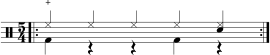
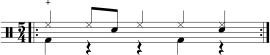
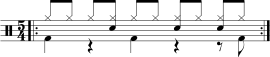
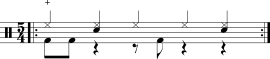
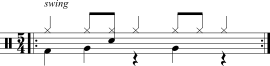
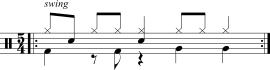
As is common in most drum set grooves, the cymbals keep the time, while the snare plays a steady type of backbeat. The bass drum adds a rhythm specific to that style that creates mutual reception with the snare adding to the layering within a drumbeat.
The following grooves can be divided into two shorter pulses that help to drive the overall groove. The first four grooves fit a rock-based or even eighth-note style while the last two are written for jazz. As you listen to the following grooves, notice the changes that take between them. The first groove starts with a simpler and more spacious sound, while the next ones add different placements for the snare and bass drum, adding in some syncopation. The two jazz grooves utilize the hi-hat with the foot, common to this style. In jazz, the more important aspect is keeping the time to set up the groove, so the cymbals play an important role. The bass drum and snare are more commonly improvised around the timekeepers, but these grooves give a possible starting point. It is also not common to play a repetitive groove in jazz like you might hear in other styles.
Groove 1.
Groove 2.
Groove 3.
Groove 4.
Groove 5.
Groove 6.
Mixed Meter Groove Examples
Mixed meter grooves are those that do not remain in one meter but are made up of two or more meters.
"Whipping Post"
Mixed meter grooves add interest and can also help define the form of a composition. The Allman Brothers song "Whipping Post" has an intro that is in 11/8 and then moves into a 12/8 groove for the verse. The Allman Brothers Band had two drummers, so the drum groove is really driving, but is more complex than one with a single drummer. This example keeps the essentials and is a simplified composite of the two parts. The 11/8 is grouped 3+3+3+2 with the kick drum and bass accenting the first note of each grouping.
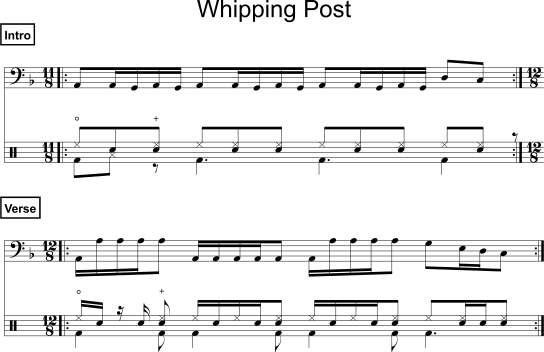
Allman Brothers. "Whipping Post," from The Allman Brothers Band. (Atco/1969).
"Outshined"
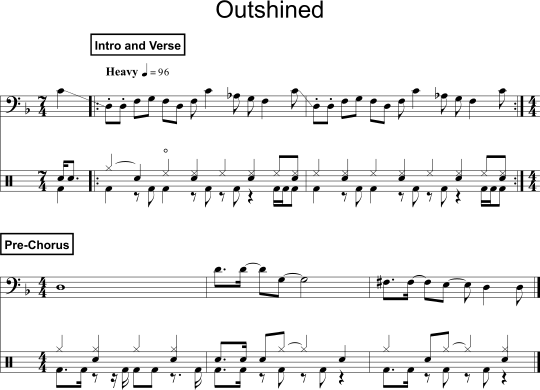
Let's look at the 7/4 groove of Soundgarden's "Outshined." The intro and verse are in 7/4, but the prechorus and chorus are in 4/4. As in "Whipping Post," the change of meter helps define the form and has an element of surprise and interest.
As in the prior bass and drum groove examples, the kick drum and bass work together to create the heavy accents and groove.
Workshop: Bass and Drums Transcription Practice
For this Bass and Drums Transcription Practice you will:
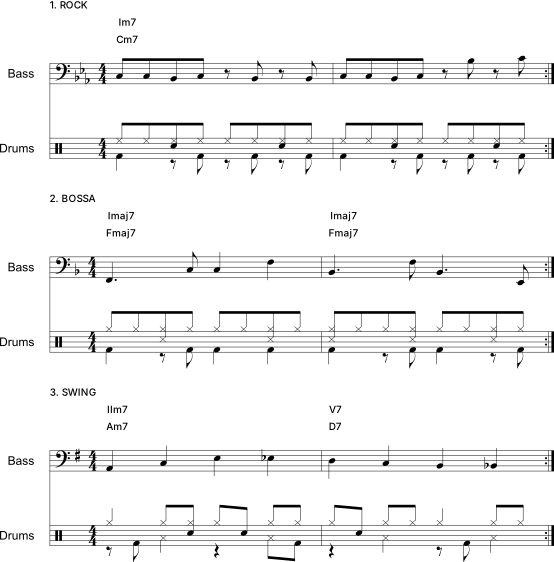
Print out the following PDF and then listen to the audio file of the three different bass and drums grooves. As you can see on the PDF, each one is two measures long. They each repeat four times on the audio file for a total of eight measures.
Download the Bass and Drums Transcription Practice (PDF)Write in the key signature, based on the given chords and Roman numerals. Then add the meter after you've listened to the grooves a few times and have identified the count. On the line, add the name of the style.
Then, listen to the groove a few more times until you are able to sing the notes of the bass part, able to tap out the rhythm of the bass, and able to tap out each component of the drum set. You might want to use an instrument, such as a piano, to help you identify the bass pitches. You can also refer to the chord symbols to help you identify the bass pitches, as well as your knowledge about how bass lines are commonly constructed.
The first and second drum grooves use three components, while the third drum groove uses four drum components. When you've identified as many of the pitches and rhythms as possible, notate the drum grooves. If you are not sure of a particular pitch or rhythm, leave it blank; you can always fill it in when you check your answers.
Bass and Drums Transcription Grooves:
Inside the Box: A Review of Form and Formal Analysis
Over the past centuries, composers and arrangers have poured their musical ideas into a variety of forms. Some of these forms have been used so often that they have become standard vehicles for communicating music. In Music Theory and Composition 1 & 2, you were introduced to a number of standard forms from both classical and contemporary music. Let's review the forms that we've covered.

Strophic Form
Bob Dylan
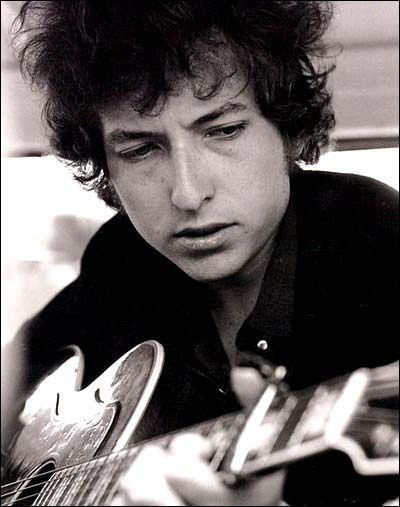
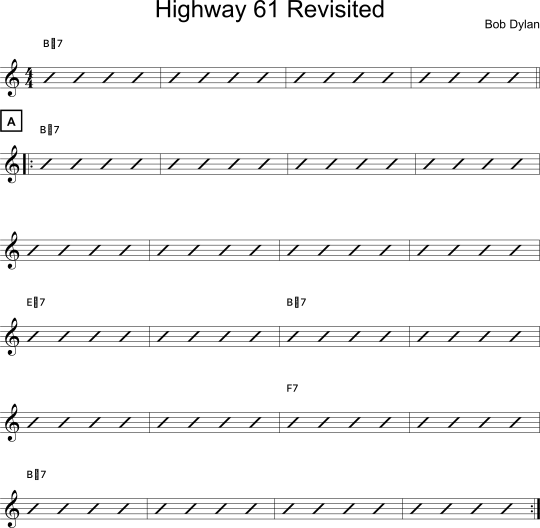
The simplest musical form is a strophic form in which the melody and chords remain very much the same and the words change with each stanza or verse. Bob Dylan's "Highway 61 Revisited" is an example of this form. The length of the repeating section in this song is 22 bars. Dylan keeps the music from getting boring by his quirky delivery and interesting lyrics. The form can be analyzed as: Intro, A1, A2, A3 . . . .
Bob Dylan. "Highway 61 Revisited," from Highway 61 Revisited. (Columbia/1965).
Binary Form
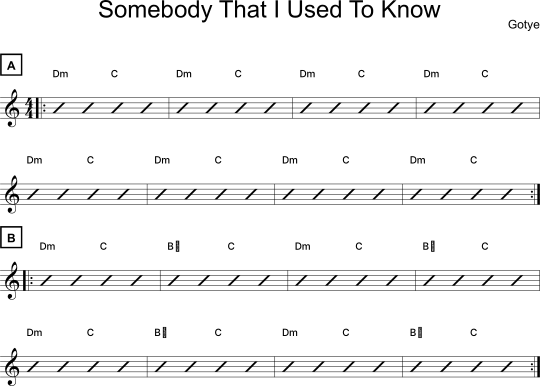
Binary form, as the words imply, is a two-part form. "Somebody That I Used To Know" by Gotye is a simple AB song. The two sections are differentiated by a slightly different chord progression and a contrasting melody in both pitch and register. In the B section, the chorus, the vocal line moves into a higher and more forceful register. The contrasting section in this case is a chorus. A chorus, in popular song form, is a distinct section that can stand on its own and is significantly different than the verse. It is different than a refrain, which is a repeated line in music that may be a tag or an ending of a verse. The refrain often has the song's hook or title. Even though there are two verses before the chorus section in this song, the repeated A section, as in the classical binary form, is still considered as one section. The form can be described as AB or |:A:|:B:|.

Gotye and Kimbra
"Hotel California"
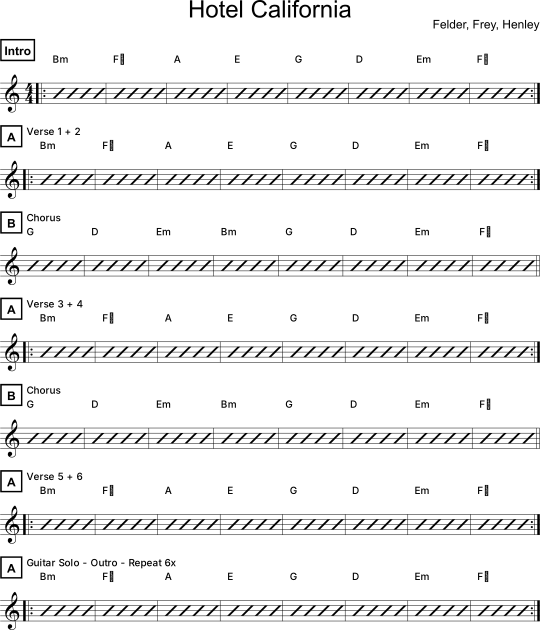
Hotel California is also constructed from two parts, an A section which holds the verses of the song, and a contrasting B section, which is the chorus. Although there is also an intro and an outro, those sections, in traditional analysis, are considered extraneous to the form.
 |
(missing audio)
|
INTRO |
A |
B |
A |
B |
A |
Outro (A) |
8+8 |
8+8 |
8 |
8+8 |
8 |
8+8 |
8+8+8+8+8+8 |
|
Verse 1 Verse 2 |
Chorus |
Verse 3 Verse 4 |
Chorus |
Verse 5 Verse 6 |
Guitar Solo |
Classical Binary Form
Anna Magdalena Bach
Classical Binary Form
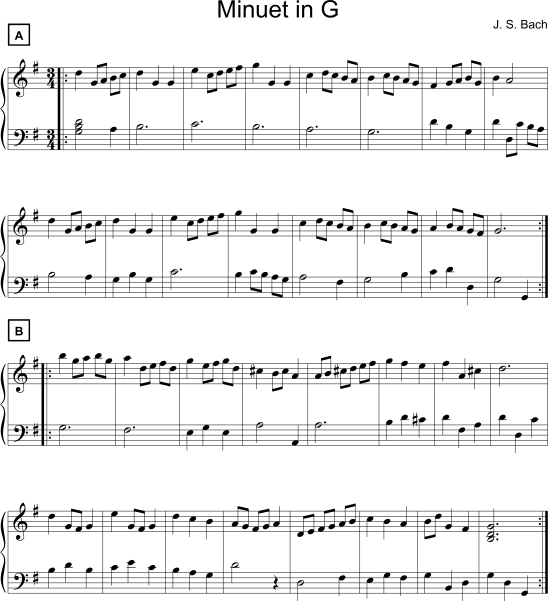
J.S. Bach's "Minuet," from his Notebook for Anna Magdalena Bach, is a clear example of a binary composition. The "A" section consists of two phrases—one open and one closed. The "B" section also consists of one open phrase and one closed phrase. Bach has also indicated that each section is to be repeated. Although the repeats lengthen the composition, repeats are generally not considered to change the formal structure of a piece.
: A : |
: B : |
8+8 |
8+8 |
Rounded Binary Form and AABA Form
The classical rounded binary form and AABA song form are quite similar. In these forms the A section repeats and is followed by a B section that is transitional with no clear cadence. The form is rounded off with a truncated or complete repetition of the A section.
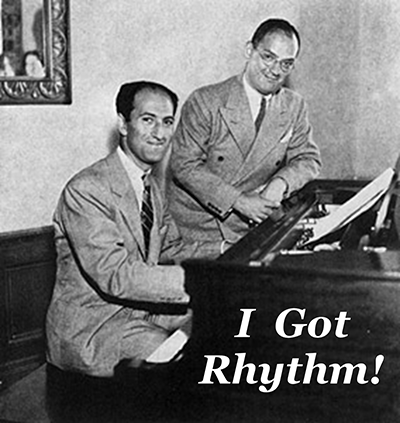
George Gershwin and Ira Gershwin
"I Got Rhythm" is a good example of AABA song form as has been used as the chord progression and formal basis of many songs.
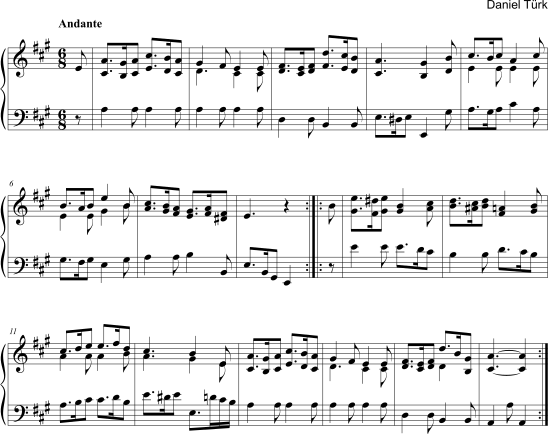
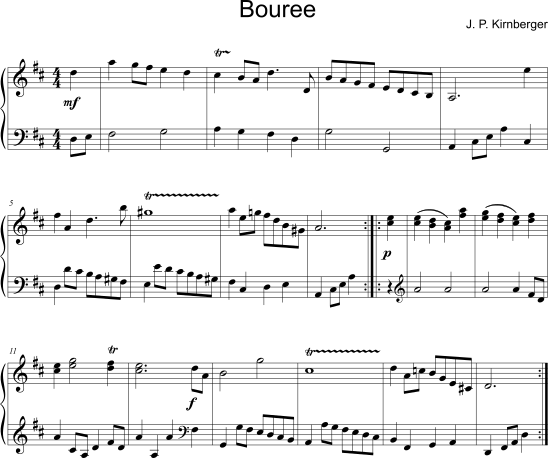
Workshop: Classical Binary Form
Listen to and look at the following compositions and write why you feel it is either in binary form or rounded binary form.
To respond to each question, click on the question tab and then click "Start" to begin typing your answer. When finished click on the "Answers" tab to compare your answers with the instructors.
12-Bar Blues Form
A 12-bar blues is considered lyrically as an AAB form, or more typically, aab with the lower case letters identifying phrases and not large sections. The chord progression of a 12-bar blues is formally just one section that keeps on repeating with new lyrics or instrumental solos (A, A1, A2, etc.). Lyrically, a typical blues has an initial phrase that is repeated and is followed by a contrasting phrase. "Hound Dog" by Elvis Presley is a good example of the rock and roll 12-bar blues form using the aab lyric form.
A - "You ain't nothin' but a hound dog, crying all the time"
A - "You ain't nothin' but a hound dog, crying all the time"
B - "Well, you ain't never caught a rabbit and you ain't no friend of mine"
Ternary Form
Ternary form, as the name implies, is a three-part form. However, it doesn't have three unique sections, Rather, it has and A section that stands alone, a B section that stands alone, and a complete return of the A section. Therefore, it can be described as ABA.
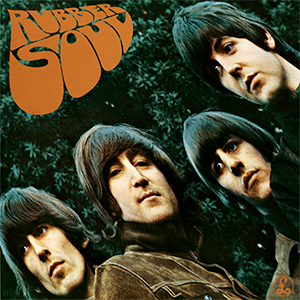
"Norwegian Wood" by the Beatles is an example of ternary form. The song starts with an instrumental introduction (remember that intros and outros aren't considered as formal sections when doing form analysis). After the intro there is a verse, chorus, and verse. The verse/chorus/verse form repeats with the first verse as an instrumental break. After the last verse, there is a short instrumental outro. The form can be analyzed as:
Intro |: A | B | A :| Outro
Here is a breakdown of the sections. Click on each labeled area to hear the section.
The Beatles. "Norwegian Wood (This Bird Has Flown)," from Rubber Soul. (EMI/1965).
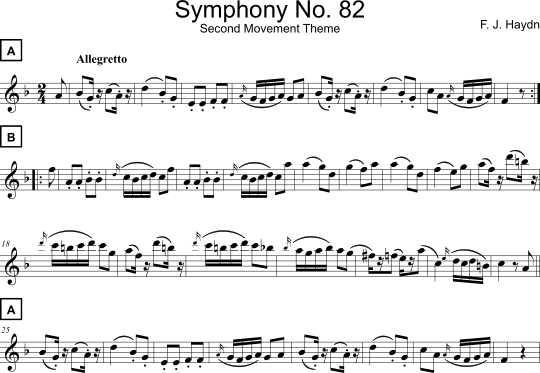
The ternary form is an often-used and standard form in classical music. Franz Joseph Haydn used the ternary form for the theme of the second movement from his Symphony No. 82. The B section modulates to the dominant (C in the key of F). Modulation to the dominant was typical in classical music forms.
ABC
Although it is more typical for a song or composition to have repeating sections, there are some that have three distinct sections. In these pieces the whole form usually cycles through two or more times.

Workshop: Form Analysis
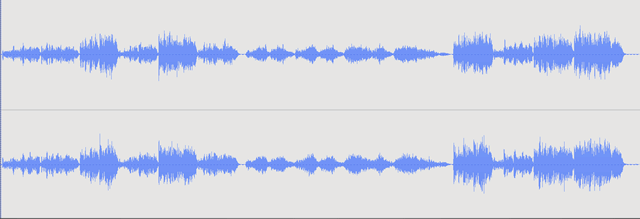
Now let's see if you can listen to and then label the starting point of each section of this piece in ternary form. Press play and listen to the piece and then drag each labeled section to the beginning of each section on the wave form.
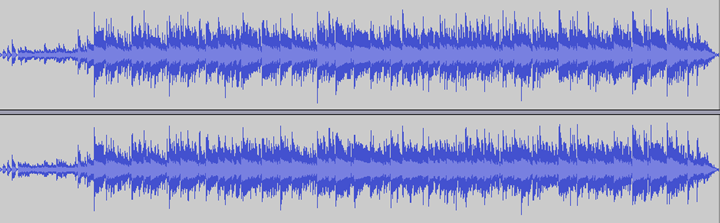
Now let's see if you can listen to and then label the song sections of this piece in A-B-A-B form. Press play and listen to the piece and then drag each labeled section to the beginning of each section on the wave form.
Bridges and Prechoruses
A bridge is a section of music that connects two longer musical sections, most often a chorus and a verse. By itself, a bridge can be described as feeling "incomplete" and doesn't stand on its own. Most often, a bridge is inserted after the second chorus. The bridge will have a contrasting sound from both the verse and the chorus. It can either contain lyrics or be purely instrumental.
In many popular songs the bridge section is inserted after the second chorus and is followed by another chorus section. This is often the point in the song that the listener is ready for something new. Some songs have the bridge in a different location, and that is often done to develop a lyrical idea. Sometimes, a bridge is simply inserted to lengthen a song.
A prechorus is just what the name says, a section of music that leads up to a chorus connecting it with a verse. In some ways it is a kind of bridge, but is typically shorter in length and builds to the chorus. Because of its building function, it is often called the rise, or the climb. The prechorus builds musical momentum and tension that is released in the chorus.
"Grenade," by Bruno Mars, uses the form ABABCB. The "A"s are the verses, the "B"s are the choruses, and the "C" is the bridge. The first two choruses have a prechorus, and there is a bridge linking the last two choruses. The resulting form is:
Verse / Prechorus / Chorus / Verse / Prechorus / Chorus / Bridge / Chorus
A score should show every note that is to be played, from beginning to end. That could make it difficult to find where a particular verse or chorus is located. Rehearsal letters are another notational element used to help organize the sections so readers can easily find their place in the music. Rehearsal letters are written in the left-hand margin at the start of each section. Since the measures in a section are set up so the first measure of a section is always the first measure of a system, then rehearsal letters will always be in the left margin. Rehearsal letters are based on the song form letters and the number of measures in each section. One rehearsal letter is applied to one full song form. If a song plays through the entire song form three times, then the rehearsal letter will be A, B, and C. The rehearsal letters are divided further by adding numbers to the letter, which is based upon the number of measures in each section.
The following charts will help you to understand rehearsal letters. The first chart is the song form structure of the song, which you know is based upon the melody and chords. The second chart shows how the rehearsal letters apply to this particular song form.
Song Form: AB with Intro and Ending
Song Form: AB with Intro and Ending:
Intro |
A |
B |
|
2 bars |
9 bars |
6 bars |
|
9 bars |
6 bars |
||
Ending 4 bars |
Rehearsal Letters: Two Times through the Song Form:
 2 bars |
 9 bars |
 6 bars |
|
 9 bars |
 6 bars |
 4 bars |
In order to understand rehearsal letter application, here are a few song forms for which you can figure out the rehearsal letters. On your own paper, write out a rehearsal letter chart that follows the structure of each song form chart. When you are done check your answers below.
1. Song Form:
Intro |
A |
B |
|
4 bars |
8 bars |
9 bars |
|
8 bars |
9 bars |
||
8 bars |
9 bars |
||
8 bars |
9 bars |
Ending 4 bars |


2. Song Form:
Intro |
A |
B |
|
4 bars |
12 bars |
8 bars |
|
12 bars |
8 bars |
||
12 bars |
8 bars |
Ending 4 bars |


Workshop: "Hotel California" Song Form Analysis
"Hotel California" by the Eagles has become a rock classic and has been covered by many, many artists. In addition to its cool lyrics, interesting chord progression, great ending guitar solo, and great sound, its success may also be due to its clear and pleasing form. Listen to "Hotel California" and create a form chart similar to the ones shown earlier in this topic. Your labels may include: Intro, "A", "B", Outro. Figure out the meter (time signature) and how many bars and phrases are in each section. It's not required, but if you'd like a challenge, create a chord chart of the song.
|
|
(missing audio)
|
Composers on Composing: Music Theory and Creativity
Each lesson in Music Theory and Composition 3 will include the topic Composers on Composing. This topic will feature videos of composers, songwriters, writers, and other artists answering questions about the creative process. Watch, listen, and reflect on the comments and insights that the artists share. Using the interviews as a starting point, contribute your thoughts to the discussion question of the week.
Artists interviewed:
Marti Epstein (composer/educator/pianist)
Eric Stern (conductor/composer/pianist)
Michael Wartofsky (songwriter/Broadway composer)
Michael Sweet (video game composer)
Bill Elliot (arranger/orchestrator)
Bonnie Hayes (songwriter)
Ayn Inserto (jazz composer)
Sheldon Mirowitz (film composer)
Omar Thomas (jazz composer)
Richard Boulanger (technologist/composer)
Winnie Dahlgren (jazz composer)
Mark Simos (songwriter)
Susan Cattaneo (singer/songwriter/producer)
Elena Roussanova (composer/pianist)
Julius Willams (composer/conductor)
Composers on Composing
For this week composers, Marti Epstein, Bill Elliot, and Bonnie Hayes were asked:
How do you begin a composition?
How do you choose your compositional materials?
Recap
I hope you enjoyed revisiting materials from Music Theory and Composition 1 and 2 and you have a good grasp of the materials in this review lesson so you will be prepared to tackle new topics that will rely on this knowledge. If you still feel uncertain about any of this material, continue to review it as needed during the term.
Next week we will be diving in and learning about extended dominant series, deceptive resolution of secondary dominants, and voice leading.